More Astronomy iPhone Apps

On August 31, 2009 I published a post of astronomy iPhone Apps. Diligent searching has resulted in some new iPhone astronomy applications that I thought you might find interesting. Check them out and be sure to let me know if you have used any of them and what you think.

Posted in Software | Leave a comment

Got a Big Dob? Need Some Accessories?

I think the companies focused on the amateur astronomy market are fascinating. Most are small but that doesn’t stop them from producing interesting innovative products. If you have a big – or not so big – dob (particularly an Obsession telescope) you might be interested in Markless™ Astronomics. They have an interesting product line that includes:

  • The Netbook Stalk II™ which allows you attach your netbook (perhaps running planetarium or star charting software) to your telescope.
  • The DSC Stalk™ II which holds your digital setting circles (Argo Navis, Sky Commander, etc).
  • The Markless™ Counterweight System which can be used to rebalance your Obsession Telescope (or most other dobsonian telescopes) after your have changed eyepieces, etc.
  • A battery bracket
  • Their Spider Wiring Kit™
  • And many other interesting items.

If you have a dob, you might want to check out their site.

Disclaimer: I don’t own any products from Markless™ Astronomics yet and I received no compensation of any type for mentioning their web site. I just thought it was interesting.

Posted in Equipment | Leave a comment

Astronomy Apps on the iPhone

As we all know, sales of smart phones are skyrocketing world-wide primarily because of the many applications that are available for these devices. I’m happy to report that amateur astronomers haven’t been left out when it comes to smart phone applications. Here’s a partial list of iPhone astronomy applications:

Did I miss one of your favorite iPhone astronomy apps? If yes, please post a comment with your recommendations.

Posted in Software | Leave a comment

Real Science – Galaxy Zoo

I am a big fan of some of the popular astronomy forums like Cloudy Nights and IceInSpace. Every once in awhile someone will submit a post that says something like "I really enjoy amateur astronomy but I would like to do some real science. How should I start?" I think this is a very interesting question and the answers are usually useful and thought provoking. Starting with this blog post I’m going to explore some of the options open to people interested in doing "real science". My first suggestion: Galaxy Zoo.

Galaxy Zoo was launched in 2007 with the basic premise that for some things your brain works better than a computer. Specifically, humans can do an excellent job classifying galaxies. When Galaxy Zoo launched they started with a data set of 1 million galaxy images taken by the Sloan Digital Sky Survey that needed to be classified into two groups – spiral galaxies and elliptical galaxies. If the galaxy was a spiral galaxy then the direction of the arms needed to be recorded. All work was to be performed by volunteers. And volunteers they got. In the first year alone almost 150,000 people volunteered to assist with this effort and 50 million classifications were done. A large number of classifications was vital because the more classifications performed the more reliable the data.

Galaxy Zoo has now moved to its second phase – Galaxy Zoo 2. In this phase 250,000 galaxies need to be further classified. Volunteers examine images of galaxies and answer a series of detailed questions about the image being analyzed. The exact number of questions can vary and is dependent upon the volunteers answer to previous questions.

If you’re interested in doing some "real science" be sure to check out Galaxy Zoo. Even if you don’t want to be a volunteer be sure to check out the web site. It’s very interesting.

Posted in Pro / Am Collaboration | 1 Comment

Kepler Detects Atmosphere on Exoplanet

One of the most interesting areas of astronomical research is the hunt for extra solar planets or exoplanets.

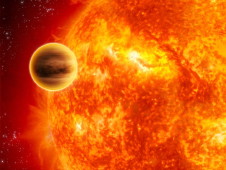
The American Kepler space telescope was designed to hunt for exoplanets in our area of the Milky Way. It was launched on March 6, 2009. Before official observing had even started – and with only 10 days of test data – Kepler made a major discovery. Kepler detected the atmosphere of a previously known exoplanet named HAT-P-7.

Hot ExoplanetThe NASA Image at the left depicts what HAT-P-7 might look like as it orbits a star located about 1,000 light years from earth. HAT-P-7 has been described as a “hot Jupiter”. It’s mass is a little bit higher than Jupiter but it is 26 times closer to its star than Jupiter is to our Sun. Because of its close proximity to its star HAT-P-7 only takes 2.2 days to complete an orbit. By comparison, it takes Jupiter almost 12 years to complete an orbit. The dayside temperature of HAT-P-7 is estimated at 4,310 degrees Fahrenheit.

The discovery of the atmosphere around this planet is not only exciting in its own right but it means Kepler is capable of great things in the future. The precision required to detect the atmosphere of this planet demonstrates that Kepler has the precision to detect earth-size planets around other stars.

You can learn more about the Kepler mission on NASA’s Kepler Overview page.

Posted in Astronomy News | Leave a comment

The sharpest views ever of Betelgeuse

BetelgeuseBetelgeuse (alpha Orionis) is one of the most well known stars. It is the second brightest star in Orion and distinguished by it’s red color. Betelgeuse is approximately 1,000 times larger than the Sun and emits more light than 100,000 Suns combined. Scientists believe Betelgeuse will become a supernova within a relatively short time – maybe within 10,000 years.

Recently the ESO (European Organization for Astronomical Research in the Southern Hemisphere) released some images showing the sharpest views ever of Betelgeuse. One of the ESO images is included to the right. This image shows a large plume of gas extending from the surface of the star into space. This plume of gas extends for a distance equal to the distance from the Sun to Neptune. Interestingly, the gas is not being ejected from the star evenly in all directions.

Why is this happening? Astronomers weren’t sure at first. They had two theories. The first theory proposed the gas was being ejected from the poles of Betelgeuse possibly because of the stars rotation. The other theory was that convection was creating the gas motions in the star. (Convection is the process you see when water boils. Hot water – which is less dense – moves from the bottom of the pan upwards and cooler water – which is more dense – moves downward.)

Additional investigation showed that gas bubbles (as large as Betelgeuse itself) are moving up and down in the star’s atmosphere. The movement of these gas bubbles is believed to be responsible for the ejection of the large plume of gas from the star’s surface.

You can read more about this research and the use of the Very Large Telescope at this link to the ESO Press Release.

Posted in Astronomy News | Leave a comment

Amateur Telescope Making in Istanbul, Kilyos

map of Turkey with IstanbulAs most of you probably know, 2009 is the International Year of Astronomy. Special events have been taking place all over the world. In my opinion, one of the most interesting events was the Amateur Telescope Making Workshop that took place over a six day period this month in Kilyos, a northern suburb of Istanbul, Turkey. The event was organized by the Istanbul Culture University. About 100 people took part in this event. 80% of the participants were specially chosen mathematics or physics teachers, 15% were astronomy students and 5% were amateur astronomers.

Those of us who weren’t lucky enough to be in Turkey for this event can still enjoy a great video created by Nurcan Ortugen Gok (Gok means sky, by the way) and Tugrul Tezcan. Be sure to check out this video – it is really well done and it’s a lot of fun! Congratulations Nurcan and Tugrul – you two did a great job!

In case you’re wondering, most of the telescopes created during this event will be used by the teachers in school astronomy clubs.

Posted in Education, Events | Leave a comment

Spectroscopy Resources

Many amateur astronomers are interested in spectroscopy but are unsure how to get started. One good way of getting started is to review the work of others. Listed below are some web resources that might prove interesting and useful.

In addition to interesting information on spectroscopy this site also discusses the issues faced by anyone interested in imaging from within a large city – like Rome, Italy.

If you know of other good resources please post them in a comment.

Posted in Spectroscopy | Leave a comment

Welcome to Share Astronomy

Welcome to Share Astronomy! This is a new web site for anyone interested in astronomy – amateur or professional. We want to provide:

  • Information and resources pertaining to astronomy, astrophysics and space exploration.
  • A place for you to showcase your work and your projects.
  • A bridge between amateur astronomers and professional astronomers.
  • A community environment where you can “meet” new people, share your thoughts, and be exposed to new concepts and ideas.

What you see today is only the first phase of Share Astronomy. We will be rolling out new features as quickly as possible. We’re excited and we think you will be too when you see what we have planned! So check back often and have fun!

Posted in Share Astronomy | Leave a comment